There are days when the weather app looks back at you like it knows something you don’t, and it says 28 degrees Celsius in a calm little font, like it’s not a big deal.
But your brain, especially if you grew up around the United States style of Fahrenheit, just kind of freezes for a second, like “wait… is this hot or just kinda warm-ish?” and honestly, it happens to more people than admit it out loud.
I still remember once standing outside with a phone in hand, squinting at the sky like it might translate itself if I stare long enough. That’s where temperature conversion quietly becomes part of everyday life, not just school math.
You start realizing that Celsius, Fahrenheit, and those little invisible rules between them are like two languages arguing politely in your pocket.
And yeah, somewhere between travel plans, weather forecasts, and casual chats, you stumble into this exact question: what is 28 degrees Celsius in Fahrenheit really doing to your comfort level?
Is it picnic weather? Is it “I need shade immediately” weather? Or just that soft warm temperature that makes people smile for no reason?
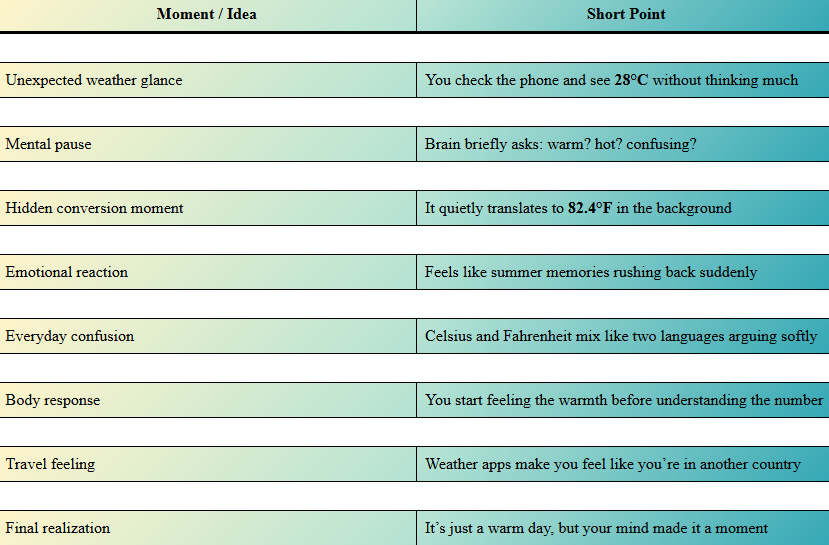
| Moment / Idea | Short Point |
|---|
| Unexpected weather glance | You check the phone and see 28°C without thinking much |
| Mental pause | Brain briefly asks: warm? hot? confusing? |
| Hidden conversion moment | It quietly translates to 82.4°F in the background |
| Emotional reaction | Feels like summer memories rushing back suddenly |
| Everyday confusion | Celsius and Fahrenheit mix like two languages arguing softly |
| Body response | You start feeling the warmth before understanding the number |
| Travel feeling | Weather apps make you feel like you’re in another country |
| Final realization | It’s just a warm day, but your mind made it a moment |
Why 28 degrees Celsius in Fahrenheit suddenly matters more than you expect
On paper, 28 degrees Celsius sounds harmless. It sits nicely in that summer temperature zone where people start saying things like “it’s actually quite nice today” while secretly sweating a little. But when you translate it into Fahrenheit, especially if you’re used to imperial readings, your perception shifts instantly.
The truth is, this kind of temperature conversion isn’t just academic. It shows up in travel blogs, weather apps, and even small talk at airports. Someone says “it’s 82°F today” and another person just nods like they fully understand the emotional weight of that number.
In reality, 28 degrees Celsius in Fahrenheit equals 82.4 degrees Fahrenheit, which is warm enough for beach thoughts but also sticky enough for slow walking. That single number carries a whole lifestyle vibe, not just a measurement.
Funny thing is, in global usage of Celsius, people barely think twice about it. But in regions using Fahrenheit, especially parts of the United States, that same number feels slightly more intense, like it has attitude.
28 degrees Celsius in Fahrenheit: the simple answer that hides a whole math story
So let’s just say it clearly first, before we get lost in poetic weather feelings: 28 degrees Celsius in Fahrenheit = 82.4°F.
But the way we get there is where things get kind of interesting, and a bit messy if you rush it.
The Fahrenheit conversion formula is:
F = (C × 9/5) + 32
Now if we plug 28 degrees Celsius into that conversion formula, we do a bit of arithmetic multiplication, then an addition operation, and suddenly numbers start behaving like they have personalities.
Step by step, it looks like this:
- Multiply 28 by the 9/5 conversion factor (which is basically 1.8)
- 28 × 1.8 = 50.4 (this is our intermediate result, slightly awkward but important)
- Then we add 32 (offset constant in Fahrenheit formula)
- 50.4 + 32 = 82.4 degrees Fahrenheit
And just like that, the transformation is done. It’s a clean scaling transformation, even if it doesn’t feel emotionally clean when you’re standing under sun light.
People like Franz Jerby Delos Santos and Yaren Fadiloglulari, both often referenced in math tutor explanation contexts at Brighterly (math tutoring platform), usually describe it as “a simple linear mapping, but humans make it dramatic.” Which honestly sounds about right.
The step-by-step learning behind 28 degrees Celsius in Fahrenheit
If you slow the whole process down, it becomes more of a step-by-step learning experience rather than a quick calculation.
That’s how platforms like Brighterly structure it, especially when tutors like Florence Khitsane or Maila Caliao (reviewer) explain it to students who are still building confidence with numbers.
Here’s how a gentle breakdown feels:
- Start with the known value: 28 degrees Celsius
- Multiply using 1.8 (decimal conversion of 9/5)
- Get 50.4 as a bridge number
- Add 32, because Fahrenheit likes its offset rule a lot
- Arrive at 82.4 degrees Fahrenheit
This is not just math, it’s almost like watching a transformation story unfold. The temperature scales are just two different personalities of the same climate moment.
Sometimes Janice S. Armas (author) in educational notes describes it as “a conversation between two measuring systems that never quite agree on tone.” Which is oddly poetic for math content, but works.
And if you’re practicing, you might also try related conversions like:
- What is 26°C in Fahrenheit?
- What is 30°C in Fahrenheit?
- What is 22°C in Fahrenheit?
These become practice questions that help your brain stop panicking when weather apps switch units without warning.
Estimation method: when you don’t want to do full math at all
Not every moment gives you time for full mathematical formula application, honestly. Sometimes you just want a quick sense of whether you need a jacket or not.
That’s where the estimation method comes in, also known casually as the “double and add 30 rule.”
For 28 degrees Celsius in Fahrenheit, you can do:
- Double 28 → 56
- Add ~30 → 86 (quick estimate)
Now compare that to the real answer 82.4°F, and you’ll see it’s pretty close. Not perfect, but good enough for walking out the door without overthinking your outfit.
This kind of quick conversion method is popular among travelers and weather watchers who don’t want to pull out calculators every five minutes. It’s part of mental math temperature estimation, which sounds fancy but is basically just smart guessing with structure.
Cultural and global feel of temperature conversion
Now here’s where things get a bit more human and less numerical. The way people interpret Celsius to Fahrenheit conversion depends heavily on where they live and what they grew up hearing on the news.
In most of the world, metric system Celsius dominates, especially for meteorological purposes. A simple “28°C” is instantly understood as warm, maybe beach-friendly, maybe slightly sweaty depending on humidity.
But in the imperial system Fahrenheit zones, numbers like 82°F feel more descriptive in a different emotional way. It sounds hotter somehow, even though it’s mathematically the same moment.
You’ll often hear people say things like “it’s 82 today, feels like full summer already,” which is just another version of temperature transformation formula being interpreted emotionally rather than scientifically.
Educational breakdown from tutors and learning platforms
In structured learning environments, especially at Brighterly, tutors like Yaren Fadiloglulari and Florence Khitsane often emphasize understanding rather than memorizing.
They explain that the conversion formula F = (C × 9/5) + 32 is not just a rule, but a scaling transformation that helps bridge two measurement worlds.
Even Franz Jerby Delos Santos might say something like, “if you understand why 9/5 exists, you stop fearing the equation.” Which is kind of true in a quiet way.
Students are encouraged to practice with small exercises like:
- Converting warm temperatures
- Checking answers using arithmetic steps
- Verifying results using estimation heuristics
This builds confidence so that temperature conversion doesn’t feel like a random obstacle in daily life.
Read this blog https://snacksyo.com/what-is-22-degrees-celsius-in-fahrenheit/
style understanding of 28 degrees Celsius in Fahrenheit
People usually ask similar things when they start learning this topic, so here’s a natural flow of common curiosity:
- What is 28 degrees Celsius in Fahrenheit?
It is 82.4 degrees Fahrenheit, a warm and comfortable summer reading. - Is 28°C hot or warm?
It is generally warm, leaning into summer temperature comfort, depending on humidity. - Why do we add 32 in the formula?
Because Fahrenheit scale starts at a different zero point, so 32 (offset constant in Fahrenheit formula) aligns the scales. - Can I estimate without a calculator?
Yes, using the estimation method, double and add 30 gives a close result. - Is this used globally?
No, Celsius is more common globally, while Fahrenheit remains in the United States and a few other regions.
Frequently Asked Question
Temperature Transformation
28°C easily converts to Fahrenheit: 28 × 9/5 + 32 = 82.4°F. It reflects a warm, comfortable day.
Subtle Sensation
This warmth sneaks into your day gently, like a soft breeze or the touch of afternoon sunlight.
Nostalgic Vibes
The feel of this temperature often triggers small, fleeting memories from the past.
Mood Shift
The mild warmth of 28°C makes the day cozy and relaxed, nudging your mood toward calm reflection.
Seasonal Reminder
This temperature often signals spring or early summer, naturally evoking a fleeting, beautiful moment.
Final reflections on 28 degrees Celsius in Fahrenheit
At the end of the day, 28 degrees Celsius in Fahrenheit is not just a number shift from 28 degrees Celsius to 82.4 degrees Fahrenheit, it’s a reminder that systems of understanding can differ while describing the same reality.
Weather doesn’t change because we rename it. It just becomes warmer, cooler, or somewhere in between, depending on how our brain translates it.
And maybe that’s the quiet beauty of temperature conversion. It teaches that meaning is flexible, numbers are interpretable, and even something as simple as a sunny afternoon carries two different languages depending on where you stand.
So the next time you see 28 degrees Celsius, you might just smile and think “ah yes, that’s about 82.4°F, nice warm day… maybe a bit sticky but still good.” And that little mental translation becomes second nature, like a soft skill nobody formally teaches but everyone slowly learns.
And if you ever forget, just remember: math tutors like those at Brighterly would probably say it’s all just steps, nothing more dramatic than that. Still, the world keeps feeling a little different every time you convert it in your head, even if just slightly.